
Dr Matthew (Matt) Evans, Clinical Psychologist
DClin Psych, University of Oxford & Bsc Psychology (Hons), University of Birmingham
How Matt Can Support You
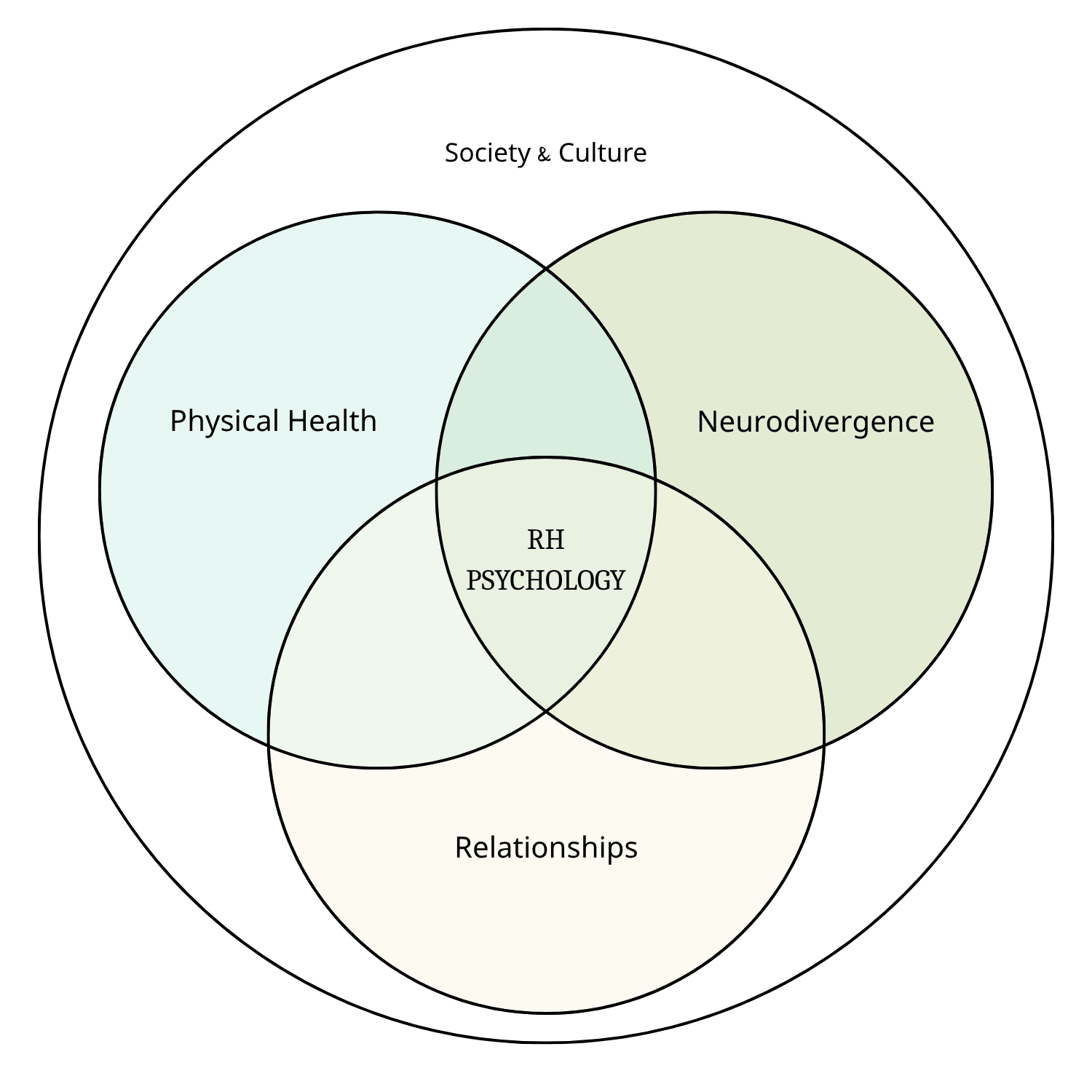
Matt helps people who are experiencing challenges relating to his main areas of experience and interest, namely, people with:
-
Whether or not physical contributors have been identified yet or not, including gut-related (Crohn’s, Ulcerative Colitis, Disorders of the Gut Brain Interaction), diabetes/endocrine, cardiac, respiratory, auto-immune conditions, persistent pain and spinal cord injury.
-
Including individual who are autistic, alexithymic, a highly sensitive person, of high ability, have ADHD and/or those with specific learning differences.
-
Current and/or historic, both in terms of close, 1:1 relationships and/or distress associated with experiences of societal marginalisation and/or difficulties with group belonging.
Matt predominantly works helping people who face challenges in many of these areas, and Matt helps his clients to manage the complex interactions between co-occurring conditions. He sees adults and adolescents, as well as kids in their final year of primary school, typically to assist them with the transition to high school.
Therapies and approaches
Matt is trained and experienced in a range of specific therapy approaches which research has shown can help people navigate the challenges that many of his clients face. These approaches include:
Individual coping strategy focused therapies, behaviour- and thought-focused therapies [e.g. Cognitive behaviour therapy (CBT), Acceptance and Commitment Therapy (ACT), Dialectical Behavioural Therapy (DBT)]
Emotional- and relationship-focused therapies [e.g. Emotionally Focused Therapy (EFT), Interpersonal Therapy (IPT) and Schema Therapy]
Social- and environmental-focused therapies [e.g. Power Threat Meaning Framework, Narrative Therapy, liberating psychology practices]
You are more than the sum of your parts, yet commonly support services can be spread across a arrange of institutions, funding regulations, providers and specialists, which can become overwhelming and ineffective. We can provide support to clients navigate, advocate and curate the services they engage with so that demands are lessened, and their needs are better met. Revival Health psychology partners with IGH to provide coordinated care for clients with gut related challenges via multidisciplinary team meetings, however, we support you in accessing, and are happy to liaise with, the medical services of your choice.
Services
-
Individual therapy
Matt also welcomes and likes to include significant others as supports for individual therapy, when his individual clients want this and if it is likely to be helpful, which is often the case when Matt is supporting with persistent health conditions and/or those who are neurodivergent.
-
Relationship therapy
Matt supports individuals and relationship irrespective of their preferences for how their relationship(s) are structured, their sexual orientation or their sexual preferences, so long actions are taken to ensure that structures and actions have been consented to by all involved parties.
-
Supervision for Psychologists
Matt is an experienced supervisor, having supervised psychologists seeking registration, both on externships in a major teaching hospital as well as those on internships at Griffith University, where he was employed to provide supervision for one day per week for several years. Matt now supervises more experienced, fully registered psychologists, particularly in the areas of persistent health, neurodivergence and relationship therapy adaptations and the support of clients with challenges in those areas.
Fees & Funding
Session Fees
60 minutes is the standard session duration. 90-minute sessions are available, typically for relationship therapy or trauma-focused interventions.
Standard fee: $255
Medicare Better Access rebate: $145.25 (out of pocket $109.25)
DVA, Bupa ADF, NDIS: no gap
Want to know more?
-
The focus of therapy depends on the “stage” that his client is currently experiencing: “survive” or “thrive”.
During “Survive” periods or “flare-ups”, a client’s distress is high and/or functioning is low. During this stage, the aim is to reduce distress, improve functioning and prevent things from getting worse until a time arises where there is more capacity to work on longer-term and “bigger picture” challenges. This stage often occurs early in therapy or during periods of acute distress, crises, life transitions or adverse events.
During “Thrive” periods or during “remission”, a client’s distress and symptoms are manageable, and their functioning allows them to invest in areas of their life that are important to them. During this stage, there is more scope to build resources, capacity and resilience as well as address longer-term vulnerabilities.
-
Matthew is a clinical psychologist, registered with the Australian Health Practitioners Regulation Agency (AHPRA). Health professionals registered with AHPRA have a strict code of conduct and ongoing professional development requirements. Not all counsellors or therapists are registered psychologists, and seeing someone who is registered ensures you receive high quality ethical treatment. Matthew also routinely collects data on his outcomes. On average about 3 out of 4 people he sees make a reliable improvement.
Matt holds a doctorate in Clinical Psychology from Oxford University, England, which he completed in 2004. He also has a Bachelor of Science degree with honours from the University of Birmingham (UK).
Prior to establishing his private practice, Matt worked for many years as the Consultant Psychologist at Royal Brisbane & Women's Hospital, where he was instrumental in changing practice and setting up specialist clinics in gastroenterology, cardiology and diabetes, helping people adjust to and manage chronic health conditions. His work also gave him varied experience working with adults with high-prevalence conditions such as depression, anxiety and adjustment disorders. In other roles he also gained experience in working with parents, adolescents and children and has undergone Triple P training as a facilitator. For many years he also supervised intern and extern students for Griffith University and the University of Queensland (UQ) and has been a tutor for medical students from UQ, training them in clinical communication skills.
In more recent years, his passion for relationships has led him to become a trained EmotionalFocused Therapy (EFT) practitioner, using this approach to help couples in relationship counselling, although he adapts aspects of the standard EFT model when appropriate to better suit the needs of clients from marginalised communities.
Matt believes that the therapeutic relationship you develop with your psychologist is an important predictor of how successful your treatment will be, so he strives to connect and establish this important relationship as the foundation of his treatment. He also routinely asks for specific feedback on your experience of the session so that he can change what he does to best suit your way of working.
-
Matt aligns with a neurodiversity-affirming approach to supporting neurodivergent clients. In doing so, he recognises that what works in therapy is not a one-size-fits-all approach.
While Matt believes it is important that clients are provided with proven, evidenced-based therapies, he also believes that while findings from large studies provide useful generalisations, marginalised groups, including neurodivergent people or those with chronic health conditions are under- represented in research, at all levels. He believes that emotional safety is pre-requisite for good therapy and that better outcomes are achieved when therapy supplements insights from the large, group-based, research findings with more specific “practice-based evidence”, such as his client’s own lived experiences outside of therapy, discussions about within therapy experiences and with knowledge gained from listening to the experiences of other members of the marginalised groups that his clients belong to. Matt believes that different approaches can work for different people in different contexts, so adapts the therapy approach and strategies when the current or previous ones do not appear to be effective. Matt is keen to hear any ideas that his clients have regarding potential adjustments he can make to his approach, communication and therapy processes to accommodate his client’s needs better.
To help ensure that any adaptations help improve the emotional safety of therapy and outcomes, Matt regularly seeks feedback from his clients on their experiences in therapy and monitors progress towards their goals. He has integrated Feedback Informed Therapy (FIT), which is a systematic way of learning “from the ground up”, into his practice for many years and has found it helpful for stimulating conversation about what is working in therapy and what isn’t.
-
coming soon
-
Coming soon
-
Coming soon
-
Coming soon
-
Matt does NOT believe that the mind and the body are separate, but different aspects of the same person. He also does NOT believe that when medical investigations fail to find a cause of someone’s physical problems that it is “all in their head”. Generally, there are three different ways that Matt can help clients with physical health problems, in collaboration with other members of your health support team:
Help reduce the distress and impact on functioning (physical, psychological, emotional, occupational, interpersonal and social)
Support you increasing behaviours which support better physical and wellbeing and a quality of life in the areas that are relevant for you
Reduce the contributions that chronic distress might be having on your body and its functioning.
-
Matt uses ideas and practices from Emotionally Focused Therapy (EFT) when he sees couples and dyads, although, when appropriate, he makes some adjustments for clients where one or both parties experience marginalization and so broader concepts of emotions and relationship security need to be incorporated into therapy.
In EFT, the therapist, rather than try to teach or coach clients, helps interrupt unhelpful communication patterns and facilitate more helpful and connecting interactions as they happen in session. The focus is on experientially learning how to change interactions for the better in session and then generalizing to interactions outside of therapy rather than learning ideas or concepts in session that then have to be implemented between sessions without the therapist there to support.
Matt typically has four sessions of pre- relationships therapy prior to agreeing to commence relationship therapy, because relationship therapy can be taxing and often there a lot is at stake if it does not go well, so Matt wants to make sure that the couples and dyads he sees are well prepared prior to starting. The format of this is that the first session is together, the next two sessions are individual sessions, where Matt and each client can have more open conversations, and the fourth sessions is together again to discuss whether to proceed to relationships therapy or explore alternatives prior to starting.
-
Matt is trained clinical psychologist so can officially diagnose both ADHD and ASD, however, he rarely does as there are other clinicians who are more experienced with diagnosis and such assessments are not funded under Medicare, so can be quite expensive.
Matt does complete clinical, rather than formal diagnostic, assessments with his clients focusing on providing useful information for therapy and to help improve clients’ functioning. With neurodivergent clients, these assessments focus on developing a personalised profile of dimensions of neurodivergence and understanding how those interact with his client’s social, physical and functional context.
-
Ideally we would see every client who might benefit from our services, however, practical restrictions mean we couldn't without making compromises that don't sit well with us. While larger clinics and organisations are able to hire new therapists if the demand for their services is high, our passion is for providing therapy, so we have kept things small and personal.
We prioritise clients who have challenges in areas that we have particular strengths or depth of experiencing in helping and areas where it can be hard to find suitable alternatives and our screening processes help us to do this efficiently.
If we are unable to offer you a service we are happy to offer suggestions as to how you can find a suitable, alternative provider.
-
Matt does not keep a waitlist for new client as he does not want his clients to have to cope with the uncertainty of being waitlisted for psychological services for an indeterminate length of time. Instead, he asked new clients to book their initial appointments after a certain date, so that he has enough appointments for existing clients, or he will let you know that he does not have capacity to see you at the time of your enquiry, so that you can find a suitable alternative.
-
The Health Practitioner Regulation National Law does not allow the use of testimonials or purported testimonials to advertise regulated health services or a business that provides a regulated health service.